
Whether it’s a molecular diagnostic device for PCR or NGS, an immunoassay, or a single-cell analysis product, in vitro diagnostic (IVD) device engineers often struggle to preserve their IVD device performance while transitioning to a mass-producible design with lower material and production costs.
With more than 20 years of experience working with market-leading IVD manufacturers, here are some challenges Enplas has helped engineers overcome—and tips on how we’ve done it.
Challenge 1:
“How can we maintain our diagnostics component’s performance while switching material to meet mass-production price targets?”
Gearing up your design for mass production often means you must give up high-cost, high-functionality materials for more cost-effective ones. Transitions may include silicone to TPE or PDMS/glass/metal to plastics.
Silicone to TPE

Glass to Plastics
Transparent plastics may be your choice for mass production consumables, but, unlike glass, autofluorescence may interfere with your detection.
With TPE and transparent plastics like COP, COC, PMMA, or other medical grade plastics such as PC and PP, our injection-molding engineers and suppliers have a wealth of knowledge in these materials. We will also provide guidance to help mitigate effects, including TPE compression set and transparent plastic autofluorescence.
Challenge 2:
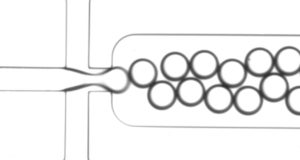
“How can we safeguard fluid and droplet performance when adjusting the design for mass production?”
Designs tested with machined or 3D-printed prototypes require design adjustments to be effectively manufacturable by injection molding. However, for IVD device components or consumables, considerations to maintain or improve functionality (not just manufacturability) are critical.
Efficient Fluid Transfer
To efficiently transfer fluids and minimize reagent dead volumes, precise through-hole locations and strict part alignments are necessary. Enplas conducts thorough failure mode and effects analyses (FMEA), focusing on essential functions to mitigate misalignment risks. In addition, we can incorporate performance checks such as leak tests in your quality plan according to specific project needs.
Droplet Performance
Challenge 3:
“How can we make smart investment choices when transitioning from prototype molds to mass-production molds?”
Final product validation requires a production-grade prototype mold to produce parts as close to those made with a mass-production mold as possible. The final production mold is an additional investment since prototypes with one or two cavities have different structures from a multi-cavity mass-production mold.
You might think, “Isn’t there a way to streamline the mold constructions to avoid fully investing in two completely separate sets of tooling and molds?”
The answer is “Yes.” If you are in the prototyping stage and eyeing transition to mass production, Enplas can create efficiencies in the process. For example, prototype molds can incorporate part of the upgrade required for mass production. In addition, proactive planning can make your prototype and mass-production mold construction faster and more cost-effective.
Challenge 4:
“How can we meet our aggressive launch date while dealing with unexpected product development issues?”
Engineers should work with a mass-production supplier that understands and meets the needs of IVD product development by offering:
- Absolute product quality while moving with speed
- The engineering knowledge to mass produce complex, functional IVD components or consumables without performance variation
- The long-term support often required for medical device development
- Flexible responses to changing needs
Conclusion
If you’re transitioning your IVD device components or consumables from prototype to mass production, Enplas can make the process easier, smoother, and more cost efficient.
Enplas is responsive, transparent, and flexible throughout the prototyping and mass-production process, whether your need is urgent, unexpected, or part of a long-term vision.
Enplas provides problem-solving ideas, implements parts and tool designs that prevent future issues, and is there when you need support—no matter how long development takes.
For questions, contact Enplas today.