Stop or Facilitate Smooth Microfluidic Flow without Chemicals or Bulky Instruments:
Hydrophilic Surface Treatments and Stop Valves
Problem
To facilitate microfluidic flow: In some plastic microfluidic channels, liquids may form bubbles or not flow smoothly, especially when transitioning from glass or PDMS. Pushing liquid flow with valves and pumps increases instrument complexity and size. The use of chemicals could also cause contamination or variance in channel dimensions. A time-consuming solution for this is an adjustment of the material contact angle.
To stop microfluidic flow: using valve and pump instruments to stop fluidic flow increases costs, complexity, and device footprint.
Solution
To facilitate microfluidic flow: Non-chemical, hydrophilic surface treatment on plastic microfluidic chips facilitates smooth liquid flow through capillary action. This treatment eliminates the need for additional pumping instruments; reduces bubbles; and nullifies the material’s contact angle. This enables easier and faster design transfer from glass or PDMS to plastics.
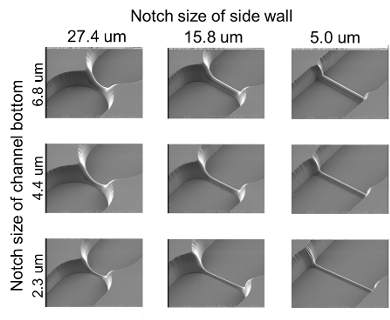
To stop microfluidic flow: The inclusion of a small notch on the microfluidic channel works as a “stop valve,” eliminating the need for external controllers. The stop valve stops the liquid flow at a specific position using surface tension.
Play Video
Hydrophilic Treatment
Smoother fluid flow (without bubbles) can be achieved with non-chemical treatments that increase hydrophilicity (i.e., the amount of water attraction) on the surfaces of molded microfluidic parts. The treated devices can fill mediums through capillary action without the use of pumps or vacuums. Hydrophilic treatments are also optimal for those who have created a microchannel design using glass or PDMS and would like to scale up using resin but cannot afford to accept a different contact angle. This treatment nullifies the material’s contact angle and the need for customers to invest time and resources into the development of new microchannels for plastic materials. Enplas’s hydrophilic treatment processes also eliminate the chance of contamination by using plasma instead of chemicals on chips laminated in a clean room. As such, no chemical residues are left that can cause variations in channel dimension.
Stop Valves
Sample flows can be controlled by adding a “stop valve,” or a small notch, that impedes a liquid’s flow through a microchannel. This solution is optimal for customers that require liquids to stop flowing at a specific location within a channel. The liquid will stop moving at the notch as the surface tension of the liquid prevents it from passing until an external force is applied. This allows fluids to be stopped in channels without any external controllers and creates a simplified device.
Play Video
Fig. A: Steady flow speed over one year equals no loss of hydrophilicity. Even if a liquid is passed through our treated channels consistently for a year, the hydrophilic surface will not decay.
Fig. B: Manipulation of the notch size provides a reliable interrupt.
Fig. C: Manipulation of the notch size provides a reliable interrupt.