
Prevent Tubes From Slipping Off Connectors:
Convexed TPE Tube Holder
Problem
In any application that deploys tubes, it’s critical to create a secure sealing surface. Many developers look to elastomer interfaces to hold tubes in place. Still, there is a risk of the tube slipping out if 1) the tube does not have a stable fit in the desired location or 2) the elastomer has been compromised with time. Furthermore, a poorly designed interface may introduce excess material and injection molding cycling, leading to increased costs. Therefore, a tube holder design and manufacturing process must be robust so that the component has the required longevity and remains cost efficient.
Solution
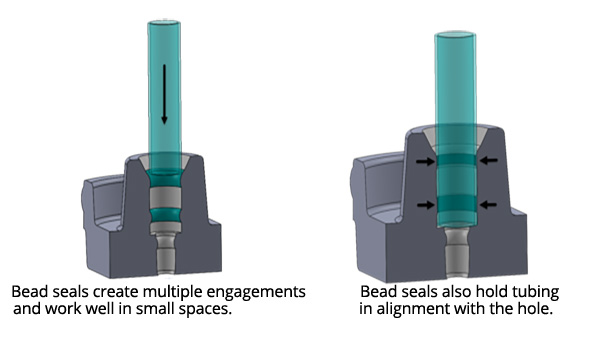
By creating the “tube-holding” pressure point in a convex shape (say, instead of a sharper pressure point or horizontal bars with wider coverage), you can achieve a stable seal AND optimize the amount of thermoplastic elastomer (TPE) used. This shape is “mold friendly,” which reduces the likelihood that the material will tear or shred during the molding process. This eliminates any fragments of loose material that may compromise sealing or the flow of liquid. This design also optimizes the injection molding cycle time and minimizes the cost of parts.

Ideal Elastomer Materials
TPEs, including thermoplastic polyurethane (TPU), are ideal manufacturable materials for this application due to their material characteristics concerning compression set, thermal durability, chemical resistance, compatibility, and effective adhesion.
Mass Production
Using TPE is a great choice for the mass production of these tube-holding seals (in contrast to liquid silicone rubber [LSR]). There are many ways to create inner-diameter pressure to hold tubes in a TPE fluid-sealing interface. However, given the material characteristics of injection-molded TPE, some designs may cause tearing of the material or not be as robust as other designs. However, a convex-shaped elastomer (or concave shape in a through-hole) is a design that allows TPE interfaces to hold tubes firmly without slippage or product failure.
Specifications
Recommended materials if you wish to chemically bond the interface with a rigid plastic body:
- Engineering plastics and other rigid plastics
- Polycarbonates (PC)
- Polypropylene (PP)
- Polystyrene (PS)
- Acrylonitrile butadiene styrene (ABS)
- Ask Enplas about other materials
- Clear/transparent plastics
- Cyclic olefin copolymers (COC)
- Cyclic olefin polymers (COP)
Example Applications:
- Sample prep
- PCR (including dPCR)
- NGS
- Other molecular testing
- Electrophoresis
- Cell handling
- Bioprocessing including Single Use Technology (SUT)
- Any other applications involving liquid and tubes, such as IVD, drug development, food testing, and more.